
Converting a glass door can improve access at a shop, office, clinic, estate lobby or public entrance, but it is not simply a matter of adding a motor. The existing leaf, its hardware and the building around it must work as one system. A door that feels light by hand may still place high loads on hinges, pivots or a top rail when it cycles repeatedly.
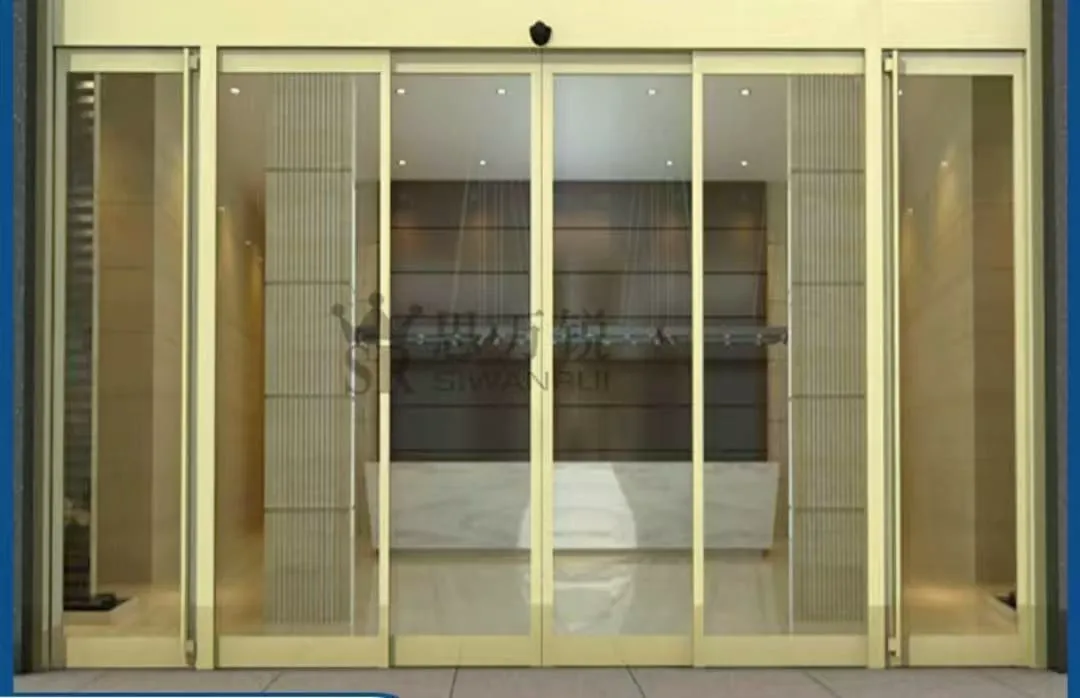
Framed glass shopfront door showing the entrance, frame and surrounding fixing area that need to be assessed for an automatic-door conversion.
1. Start with the complete door assembly
Begin by identifying how the leaf is supported and how it moves. A framed shopfront door may transfer load through a frame and hinges, while a frameless door may rely on patch fittings, a floor spring or an overhead pivot. A sliding glass door has different requirements again: the top track, rollers, fixed panels, stops and side clearances all affect whether an automatic rail can be installed. Photograph the full entrance and both sides so the surrounding construction is visible.
Open and close the door slowly by hand only if it is safe to do so. Notice binding, a door that drifts, a leaf that drops, rattling hardware, cracked glass, damaged seals or a gap that changes along the floor. These are not minor cosmetic points; an operator can amplify an existing alignment or support problem. Stop if the glass is damaged, a fitting is loose or the leaf is difficult to control, and arrange an inspection rather than forcing it.
- Record the door type: framed, frameless, single leaf, pair, swing or sliding.
- Look for cracks, chipped edges, loose patch fittings, sagging, rubbing or uneven gaps.
- Check whether the top frame, transom or wall can carry an operator or rail.
- Note clear opening, nearby walls, steps, wind exposure and the route of users.
2. Match the operator to real use
An operator is selected around the door leaf weight and geometry, the opening or sliding length, the expected frequency of use and the environment. A clinic may need predictable, quiet movement near patients; a shopfront may face repeated peak traffic and wind; an estate lobby may combine residents, deliveries and access control. Tell the installer how people actually use the entrance, including trolleys, wheelchairs, children, luggage and two-way traffic. This information changes the sensible operating arrangement and sensor layout.
Check the physical envelope before equipment is chosen. Swing operators need a secure mounting point, arm clearance and a door path that does not strike a wall, display or person. Sliding systems need a straight, supported track and enough headroom for the operator and rail, with space to remove covers and service rollers. In coastal or persistently damp locations, ask for an assessment of corrosion risk, suitable materials and surface treatment; cleaning water and salt deposits can affect fittings and moving parts.
- Measure the clear passage with the door in its normal open position.
- Estimate daily cycles and peak periods rather than relying on a vague ‘busy’ label.
- Allow room for the operator cover, rail, arm, sensor and future servicing.
- Consider noise, draughts, rain, salt air, dust and cleaning routines.
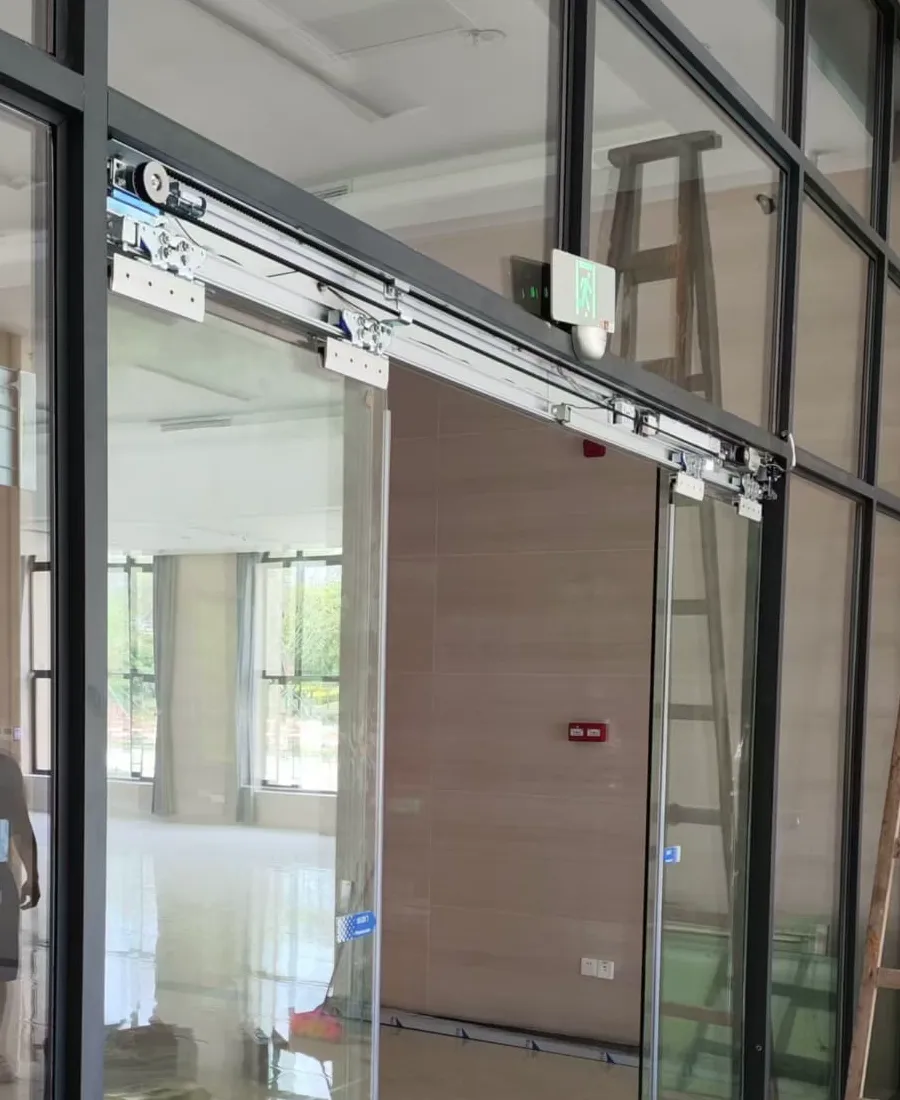
Automatic door operator and rail viewed at the head of an entrance, with components that require space, secure fixing and maintenance access.
3. Plan sensors, access and power
The activation sensor tells the door to start a cycle when a person approaches. A safety sensor monitors the movement area and helps prevent the leaf from closing into a person or object. They have different positions, fields and purposes, so one cannot be substituted for the other. During a site discussion, ask the installer to point out each detection zone, including the approach side, the threshold and the sweep of a swing leaf. Keep those zones clear of signs, hanging plants, displays and stored goods.
If the entrance has a card reader, keypad, intercom or timed release, decide whether the door should open for authorised users only, for everyone, or through a combination of modes. Discuss the logic for a mains failure: whether a back-up supply is needed, how long controlled access should remain available, and how people can pass safely if power or a controller fails. Fire, escape and accessibility matters are site-specific; use these as coordination prompts and confirm the final arrangement against the relevant professional requirements.
- Separate the activation sensor from the safety sensor in the door zone.
- Confirm where access readers, push buttons, intercoms and emergency release devices will sit.
- Define the intended behaviour during a power failure before installation.
- Coordinate any fire, escape or accessibility requirements with the responsible professional.
4. Confirm glass and fixing details
The glass specification is only one part of the decision. Record whether the panel is toughened, laminated or another type, together with its dimensions, estimated weight, edge finish, holes, cut-outs and the patch or frame hardware already fitted. Do not assume that a thicker panel is automatically better for conversion. The operator load, clamp arrangement, pivot or hinge geometry and the condition of the edges must all be compatible, and any required holes or notches should be confirmed before work is planned.
Ask how the operator or rail will be fixed and where its forces travel. A sound-looking ceiling finish may conceal a weak substrate, services or a non-structural lining. The installer may need to expose a fixing point, add support or choose a different arrangement. Existing locks, floor springs, door closers, seals and access-control wiring can also interfere with movement. A proper survey should record these interfaces and define protection for the glass while drilling, lifting, wiring and commissioning take place.
- Inspect glass type, dimensions, edge condition, holes, notches and fittings.
- Check the load path from the operator or rail into the frame, wall or structure.
- Verify that replacement or new hardware will not clash with existing locks or closers.
- Plan how the door will be isolated and protected during drilling, wiring and testing.
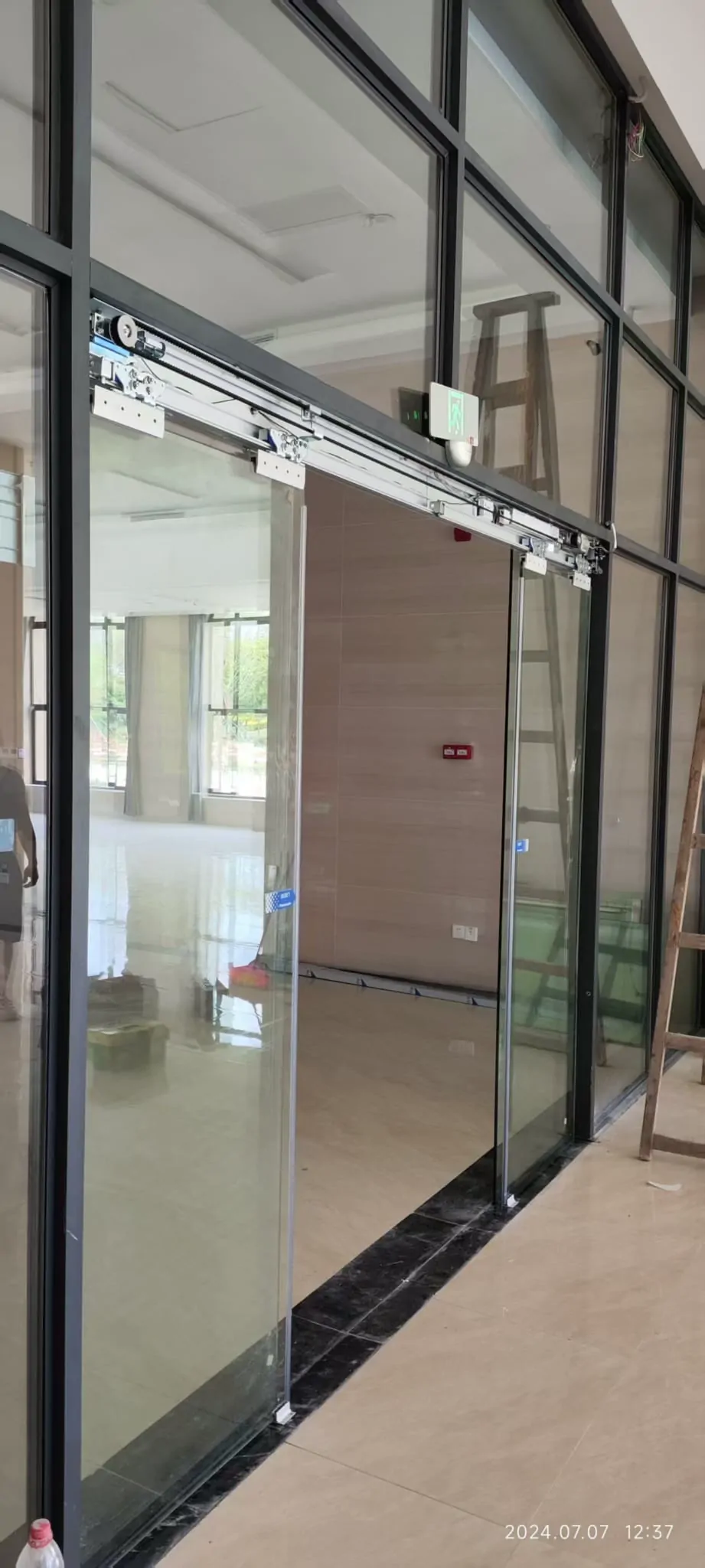
Glass automatic-door assembly with operator and fittings visible; the image illustrates components to document during a site check.
5. Decide, document and maintain
After the survey, ask for a written description of the proposed arrangement: operator location, mounting method, sensor positions, access-control interface, back-up power and the intended power-cut state. A useful decision is not only ‘can it be motorised?’ but also ‘will it remain serviceable in this entrance?’ Check that there is room to reach the controller, adjust sensors and replace wear parts without dismantling the whole glass assembly. If the existing leaf is distorted, damaged or poorly aligned, repairing or replacing hardware may be the safer first step.
For ongoing care, keep the sensing area free from posters, stock, plants and temporary barriers. Clean the lenses and surrounding glass gently, keep sliding tracks and swing paths free of grit, and listen for new noises. Do not bypass a safety sensor or repeatedly reset a fault without finding its cause. For an initial remote review, provide an entrance-wide photo, the operator or rail label, indicator lights, close-ups of hinges or patch fittings, and a short video with sound showing a full cycle. These can highlight visible symptoms, but a technician must still verify hidden fixings, glass integrity, alignment, structural support and safe operation on site.
- Keep the entrance clear and clean the sensor lenses according to the equipment instructions.
- Remove grit and debris around tracks, thresholds and swing paths without forcing parts.
- Record unusual clicking, scraping, delayed starts, rebounds or repeated re-opening.
- Arrange service when movement, safety detection or hardware condition changes.
Common questions
Can any glass door be made automatic?
Sometimes. A frameless or framed leaf may be suitable, but the hinges, patch fittings, floor or overhead pivot, glass edge condition, support above the opening and available operator space must be checked together. An operator must not be attached to glass or a weak frame without confirming the load path.
What should I check before requesting conversion?
Not reliably. Measure the clear opening, observe the door’s weight and swing or sliding path, and check whether the head can carry an operator or whether a sliding rail can be fixed securely. Also identify how users enter, whether the entrance is windy or coastal, and what should happen during a power cut. A technician should confirm the measurements and mounting details before ordering equipment.
Can you diagnose conversion suitability from photos?
Photos can support an initial discussion, not approve an installation. An entrance-wide image, close-ups of the operator area, hinges or patch fittings, door labels, indicator lights and a short opening-and-closing video with sound can reveal obvious constraints or symptoms. Hidden fixings, glass condition, structural capacity, alignment and safety performance still need an on-site inspection.
Send entrance photos on WhatsApp
If you are unsure, send a few clear photos to WhatsApp: one of the whole entrance, one of the top rail or frame, one showing the glass hardware, and a short video with sound of the door moving. We can indicate what needs checking on site; final suitability still requires an inspection.