
A sliding automatic door that shuts faster than expected can make visitors hesitate, catch someone who is walking slowly, or strike a trolley before the person using it has cleared the opening. The issue is not simply whether the door still opens and closes. The important question is whether its movement remains predictable and whether the doorway protection responds in the real conditions of your shop, office, clinic, estate entrance or shared public area.
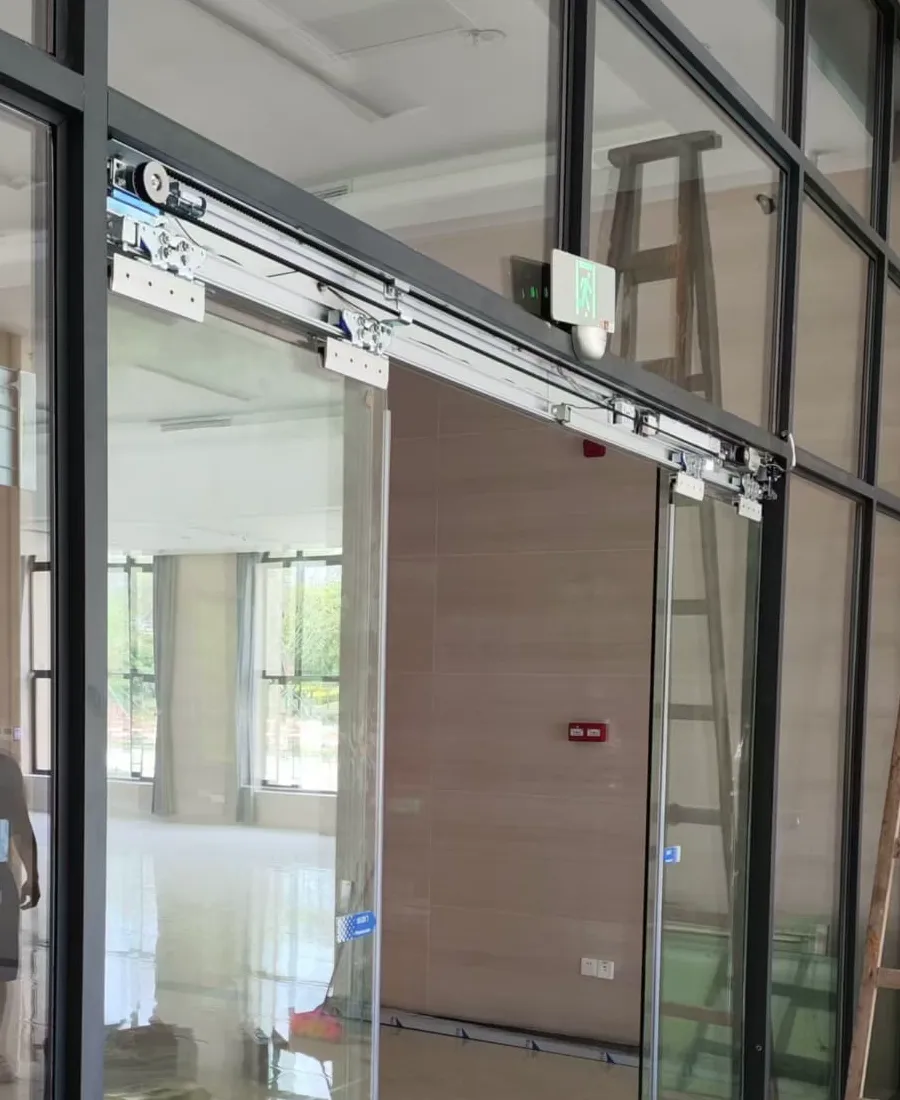
Automatic door operator and rail components above a glazed entrance.
First decide whether to keep using it
Start by observing from a safe distance. Does the door close quickly on every cycle, or only after it has stayed open for a short time? Does it make a new scraping, knocking or strained motor sound? Notice whether it closes normally when the entrance is quiet but behaves differently when people pass through in succession. A door that is merely set to a short hold-open period can feel rushed; a door that accelerates, jolts, rebounds or closes unevenly is a different concern.
Temporarily keeping the entrance supervised may be appropriate while you arrange help, provided the door can still be used safely and the route is not obstructed. Do not wedge an automatic door open, force its leaves apart, or disable sensors to make traffic easier. If someone could be struck, trapped, or unable to use the entrance safely, avoid operating the door and use an appropriate alternative access route where available. Emergency escape, fire-related functions and accessible access arrangements must be confirmed against the actual site and relevant professional requirements.
- Keep pedestrians, children, wheeled equipment and loose items clear of the doorway.
- Do not try to slow a moving door by holding its glass, edge or belt area.
- Record when the symptom occurs and whether it is repeatable.
Separate opening detection from doorway safety
Many entrances have a sensor that detects an approaching user and tells the door to open. They may also have a separate safety sensor that monitors the door zone while the leaf is moving. Their roles are different. If an activation sensor misses a person, the door may not open when expected. If the safety protection is not detecting properly, the doorway may not respond as it should when someone or something is in the closing path. Neither finding by itself proves why the closing speed feels too high.
From a safe position, look for obvious contamination on sensor faces, a sign, poster, plant or decoration newly placed in the detection area, and physical damage caused by a trolley or cleaning equipment. Do not use a hand, body, stick or object to test a closing door. A controlled functional test should be carried out by a competent technician using the actual equipment arrangement. Tell the technician if lighting, reflective flooring, direct sun, rain or a new display was present when the behaviour changed, because site conditions can matter.
- Compare the movement from fully open to fully closed, not only the final few centimetres.
- Look for a dirty cover, loose object, damaged casing or changed sensor alignment without touching it.
- Check whether weather, sunlight, queues or delivery trolleys coincide with the problem.
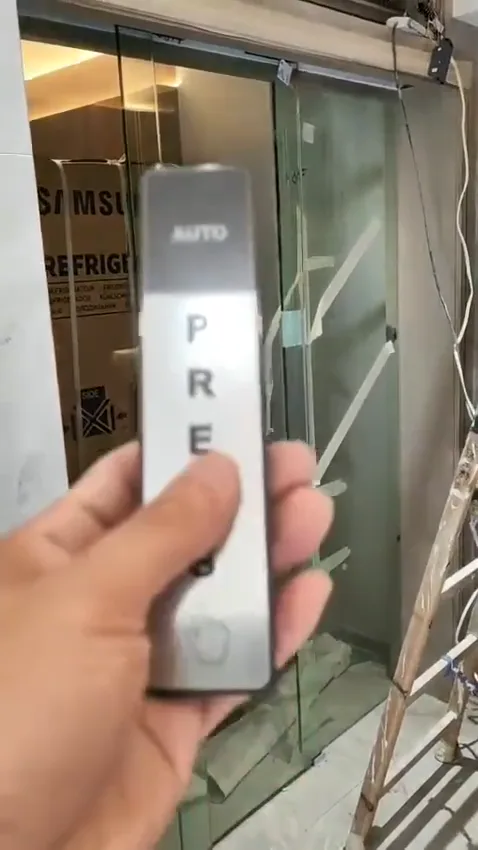
Touchless control and sensor equipment used at an automatic doorway.
Look for movement and track clues
Listen for signs that the mechanism is working harder than usual: rubbing through the travel, a repeated click, a sudden knock near the end stop, or a motor sound that rises and falls. Look at the door from the side when it is stationary. A leaf that appears to sit lower than before, has an uneven gap, or brushes a seal or frame may be creating resistance. On glass doors, avoid pressing on the glass or attempting to straighten the leaf yourself.
Check the visible floor and track surroundings for grit, tape, packaging, fallen hardware or anything that could interfere with travel. Routine housekeeping is useful: keep the track area clear, clean the sensor zone and report unusual sounds early. However, a clear track does not confirm that the internal rollers, belt, guide, operator setting or door weight balance are satisfactory. Closing speed, force and safety response should be considered together, rather than changing one control in isolation.
- Watch for a change in speed, hesitation, rebound, noise or leaf alignment.
- Keep the track surround clear of packaging, grit and other loose material.
- Do not remove covers or apply lubricant unless specified for the system.
Collect evidence that helps an initial diagnosis
A useful video begins before the door is activated, shows the full doorway, and continues until the leaves are fully closed. Keep a safe distance and include the sound, as a knock, scrape or repeated clicking can be informative. If possible, take another clip during a normal cycle for comparison. Avoid filming identifiable visitors where possible, and do not ask a person to stand in the closing path for the recording.
Photos should include the whole entrance, the operator from a safe accessible position, the label or model information, sensor locations, the floor guide or track area, and any visible warning light. Add a short note on when the issue began, whether it followed cleaning, a knock, a power interruption or changes at the entrance, and how often it happens. State whether the door is a single or bi-parting sliding arrangement and whether access control, a push button, a touchless control or other linked equipment is involved.
- Take one wide entrance photo and one photo of the operator label.
- Film a complete opening-and-closing cycle, including the sound.
- Photograph any indicator light or visible damage without opening the cover.
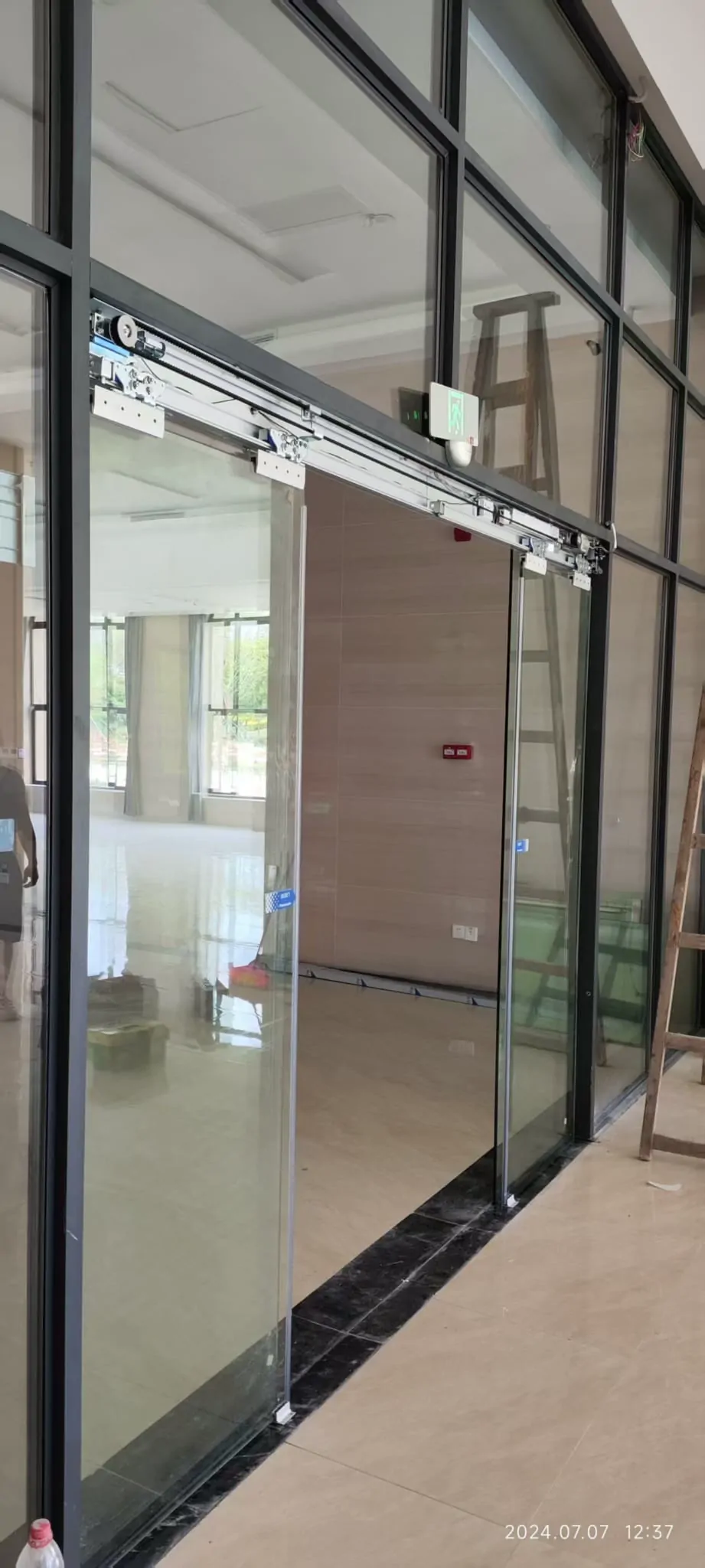
Glazed automatic door system showing the operator area and door leaves.
What an on-site check should cover
An on-site assessment can examine the door leaf weight and condition, opening width, movement through the rail, operator response, sensor coverage and the final closing behaviour. The operator is not selected or adjusted by size alone: door weight, doorway dimensions, frequency of use, surrounding environment, noise expectations and ongoing parts support all matter. A busy clinic entrance, a sheltered office doorway and a damp external access point may present different conditions even if the doors look similar.
Tell the technician about any connected access control, backup power, intercom, fire-related interface or expected behaviour during a power interruption. These functions should be considered during design and adjustment, not treated as separate additions after the door has been altered. Do not assume that a rapid close is safer or that a slower close is always suitable. The aim is a stable, correctly protected movement that suits the particular doorway and allows people to pass through with confidence.
- Ask for speed, force, travel, sensor coverage and door condition to be checked as one system.
- Mention access control, backup power and any emergency or fire-related interface.
- Confirm the safe operating logic before changing how people use the entrance.
Common questions
Is a dirty sensor why the door closes too fast?
Do not assume that a sensor problem is the cause. A safety sensor and an activation sensor do different jobs: one detects a person or object in the doorway, while the other asks the door to open. A blocked, misaligned or damaged safety sensor may affect how the doorway is protected, but a fast closing movement can also come from the operator settings, resistance in the track, worn components or an unsuitable door setup. Keep clear of the opening and arrange a proper inspection if the closing movement is abrupt or inconsistent.
Can our staff adjust the closing speed?
It is sensible to clear loose items around the track and gently clean the sensor cover with a dry, soft cloth if it is accessible. Do not alter wiring, open the operator cover, move sensor brackets or change force and speed settings. Those adjustments interact with the door’s weight, travel and safety protection. If the door is on a busy public route, has a glass leaf, or behaves unpredictably, stop relying on it until it has been assessed.
What should I send for a remote first check?
A short video is most useful when it shows the full entrance, from fully open through to fully closed, with sound. Also send a close photo of the operator label, the sensor positions, the track area and any indicator lights. Mention whether the problem happens every time, only after a power interruption, at certain times of day, or when the entrance is wet, crowded or windy. These details support an initial discussion but do not replace checking the equipment in person.
Send a few photos on WhatsApp
If you would like a practical first view, send the entrance photos, the operator label and a short video with sound to us on WhatsApp. We can help identify what should be checked on site.